
At the end of a long clinic day, doctors often exhibit a certain kind of fatigue that has little to do with the patients they actually saw. The hours spent crouched over a laptop at home, completing notes, closing charts, and navigating dropdown menus created by someone who has probably never met a patient are what matter. American medicine has been subtly sacrificing something for almost 20 years since the federal push for electronic health records started in earnest. mostly eye contact. existence. The kind of leisurely listening that once characterized a successful visit.
The academic system affiliated with the University of Toledo in Ohio, UToledo Health, has been conducting an experiment that suggests what it might be like to reverse that trade. The system increased its use of Nabla’s ambient AI documentation tool within its Epic environment following an eight-week evaluation, and the numbers it is reporting are the kind that make hospital administrators lean forward in their chairs. In a brief period of time, the number of open charts—that quiet, unglamorous backlog that every clinician carries around like a guilty conscience—dropped from over 400 to less than 30. The chart closure time improvement, according to Becker’s Hospital Review, is 29%. This may seem insignificant, but keep in mind that it compounds across all clinicians, every encounter, and every week.
| Field | Details |
|---|---|
| Institution | University of Toledo Health |
| Location | Toledo, Ohio, United States |
| Key Figure | Dr. Ryan Sadeghian, Chief Medical Informatics Officer |
| Technology Partner | Nabla (ambient clinical AI) |
| EHR System | Epic |
| Evaluation Period | Eight-week pilot, expanded April 2026 |
| Reported Outcome | Open charts dropped from 400+ to fewer than 30 |
| Chart Closure Improvement | 29% faster (per Becker’s Hospital Review) |
| Regulatory Framework | HIPAA Privacy and Security Rules |
| Industry Context | Clinician burnout flagged as a top concern by the American Medical Association |
| Co-Chair Role | HIMSS Physicians Committee |
| Reporting Source | Healthcare IT News, April 30, 2026 |
The chief medical informatics officer for the system, Dr. Ryan Sadeghian, has been cautious in his explanation of the situation. He discusses timely documentation, accurate coding, and the consequences for billing and compliance. It is not a missionary’s language, but an operator’s. However, there is more when you look past the obvious. Once more, he speaks of clinicians being “fully present” with patients, as though this were a clinical metric. Perhaps it should be, in a sense.
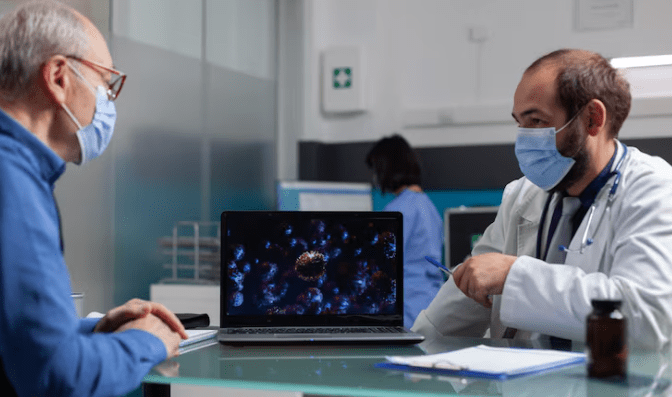
The mechanics are surprisingly straightforward. In the background, ambient AI tools create a structured note while listening to the doctor and patient’s conversation. After editing and signing, the clinician proceeds. No documentation marathon after hours. When someone is trying to describe a chest pain, don’t stare at the screen. Although early results from organizations like Permanente and UChicago Medicine are encouraging, it is still unclear whether the technology truly functions as advertised across specialties. A hospital is not a research paper, and there is a huge difference between a busy urgent care center and a considerate internist.
Additionally, there is the issue of what the device is doing with the audio it records; this is the type of question that HIPAA was designed to address, though not precisely. Covered entities must interpret current regulations on their own because the HHS Office for Civil Rights has not yet released specific guidelines for ambient AI in clinical settings. That regulatory gap is big enough to allow an ambulance to pass through, and it will be filled—probably the hard way.
Even so, it seems insignificant to pass a clinic where a doctor is actually looking at a patient rather than a screen. The way American medicine uses its most limited resource—money—seems to be changing. Attention has always been the key. The question that no one can answer is whether ambient AI fulfills that promise at scale or if it creates a new set of issues that no one has yet to identify. Not just yet. However, it appears that the trade may go the other way for the first time in a long time.
