

Within Google DeepMind’s healthcare division, a significant change is occurring somewhere between the quiet research papers and the polished marketing language. The lab has been steadily advancing into the more complex field of clinical medicine. It is well-known for having cracked protein folding and outperforming humans at Go. Additionally, the most recent announcement—an initiative they refer to as the AI co-clinician—feels more like a sign of the direction this entire field is taking than a product launch.
Although the execution isn’t simple, the concept is. For years, the World Health Organization has warned that there will be a shortage of over ten million health workers by 2030. Hospitals are overburdened. In some parts of the US and the UK, primary care waitlists are already weeks long. In rural India, doctors may see hundreds of patients in a single day. In light of this, the notion of an AI agent operating under a doctor’s supervision and assisting patients in between appointments seems more like infrastructure than science fiction.
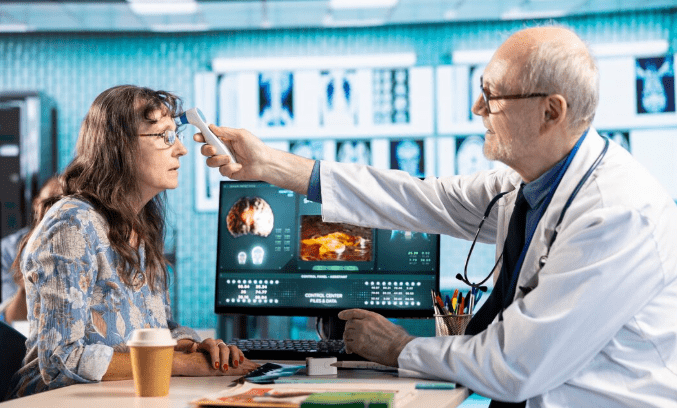
Researchers at Google DeepMind, such as Alan Karthikesalingam and Pushmeet Kohli, refer to the model as triadic care—an awkward term that is likely to stick. The AI agent, the patient, and the physician are all in the same loop. The agent is not the only one who diagnoses. It presents evidence, poses follow-up queries, creates summaries, and highlights discrepancies. Even the team behind it seems cautious not to overpromise whether that truly lessens a clinician’s workload or just shifts the bottleneck.
However, the numbers mentioned are intriguing. The system outperformed two AI tools that doctors currently use in a blind evaluation of 98 realistic primary care queries, recording zero critical errors in 97 of them. That is the type of outcome that is cited in pitch decks and LinkedIn posts. However, the decision to measure both errors of commission—saying something incorrectly—and errors of omission—not mentioning something crucial—was what caught my attention when I read the research framing. In medicine, the second one is the more subdued killer. That’s what most doctors will tell you.
This arc is also longer. MedPaLM, which was essentially a model adept at passing medical exams, marked the beginning of DeepMind’s medical work. After that, AMIE entered the realm of simulated consultations. With every step, the real texture of clinical practice—with all of its ambiguity—has become more apparent. It’s difficult to ignore the pattern. They are not attempting to create a substitute for the doctor. They are attempting to create something that the doctor can manually adjust without fear of an incorrect result.
It is another matter entirely if the medical community accepts this. Physicians have witnessed many AI tools come with bold claims and then quietly vanish. Due to years of unfinished electronic health record rollouts and untrusted decision-support systems, there is a healthy amount of skepticism in clinical settings. Despite what the headlines at the time suggested, the history of medical AI has been more about friction than transformation.
However, this round feels different in some way. The size of the models or the way the research is organized around safety frameworks like the modified NOHARM benchmark could be the cause. Perhaps it’s just that it’s now impossible to ignore the global staffing crisis, and any tool that increases a doctor’s reach will be taken seriously. Currently, the work is largely invisible outside of research hospitals in Mountain View and London. The trials are starting inside.
Whether AI co-clinicians become the new standard or are just another impressive demonstration that has trouble in the real world is still up in the air. However, the next ten years of medicine are being subtly planned somewhere in that space between promise and evidence.
