
You’ll notice something that wasn’t quite there ten years ago if you walk into practically any school pickup line in the late afternoon. Parents are a little quieter as they browse through their phones, feeling a certain kind of fatigue that is unrelated to sleep. It’s the burden of trying to raise children when no one has given her a map, according to a mother in Hilliard, Ohio. It turns out that this sentiment is now statistically nearly universal.
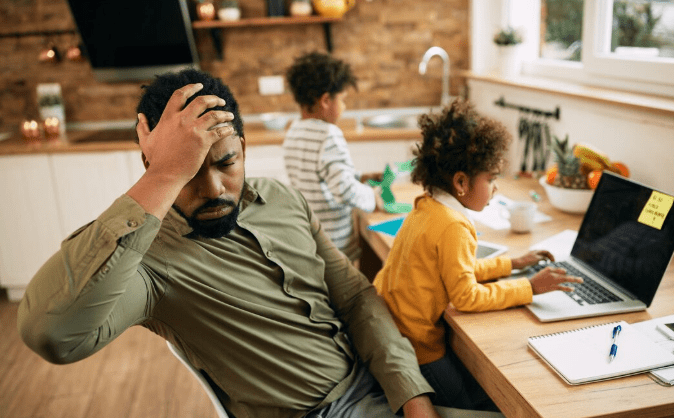
97% of American parents with children under the age of 18 reported feeling stressed in the previous month, according to a recent nationwide survey done by Ipsos for The Kids Mental Health Foundation. Almost one-third said it occurs frequently. The finding feels different from anything we’ve heard before because of the source of the stress, even though the number itself is striking. Money, schooling, and even physical safety are not the main concerns of parents. They are concerned about the mental health of their kids.
| Key Information | Details |
|---|---|
| Report Title | The Kids Mental Health Foundation National Parental Stress Survey 2026 |
| Conducted By | Ipsos, on behalf of The Kids Mental Health Foundation (founded by Nationwide Children’s Hospital) |
| Survey Size | More than 1,000 parents across the United States |
| Parents Reporting Stress | 97% of parents of children under 18 in the past month |
| Parents Reporting Frequent Stress | 30% said they felt stressed “often” |
| Top Stress Sources | Children’s behavioral issues (35%); children’s emotional or mental health (26%) |
| Spillover Effect | 46% of stressed parents say their stress makes their children more anxious |
| Related Mott Poll Finding | 83% of parents believe U.S. children’s mental health is getting worse |
| Expert Cited | Dr. Ariana Hoet, Executive Clinical Director, Kids Mental Health Foundation |
| Date Published | April 29, 2026 |
At 35%, behavioral problems were at the top of the list, followed by emotional and mental health at 26%. The data also reveals a darker loop, with 46% of anxious parents acknowledging that they believe their own anxiety is causing their children to become more anxious. It’s the type of cycle therapy that therapists have been quietly warning about for years, and it’s now difficult to ignore when it appears in survey form.
Dr. Ariana Hoet, who oversees the clinical division of the foundation at Nationwide Children’s Hospital, put it simply. According to her, this generation of parents is the first to truly try this, the first to make mental wellness a daily habit at home rather than something that is dealt with in a crisis. Grandparents did not leave behind a blueprint. Nowadays, the majority of adults who are raising children were raised in homes where emotions were something to be overcome rather than something to sit with. They are now being asked to perform the opposite action in real time without any guidance.
It’s difficult to ignore how much of this coincides with another obvious shift. According to a University of Michigan Mott poll from 2025, 83% of parents think that the mental health of American children is declining, and the majority cited social media and screen time as contributing factors. For years, Jonathan Haidt, the social scientist who wrote The Anxious Generation, has been making the case that gadgets are subtly altering childhood. He has observed that the typical child uses a screen for eight to ten hours every day outside of school. It should probably frighten more people than it does.
Beneath all of this, there’s a tiredness that seems almost generational. On the same phones that their children are addicted to, parents are reading about regulation theory, gentle parenting, and dopamine loops at a rate that their own parents were never required to. The irony speaks for itself. Families are left in a peculiar limbo, more conscious of mental health than before but unsure of how to deal with it.
The Hilliard mother quoted in the foundation’s press release, Allison Tomlin, made a statement that sticks in people’s minds. She noticed that parents frequently try to address the emotion rather than listen to it, which causes the child to shut down because they feel like a problem rather than a person. It’s a minor difference. Perhaps it’s the entire thing.
It’s unclear what will happen next. Dr. Hoet advises parents to prioritize their own well-being, make small adjustments, have daily conversations, and correct mistakes. Simple, almost unglamorous advice. However, it seems that the families who stop striving for perfection and instead focus on being present will be the ones who survive this phase in the healthiest way. It remains to be seen if that is sufficient in the face of schedules, screens, and other distractions.
