


In older American cities, there’s a particular type of building that you pass without really noticing. For many years, one of those was the Connelley Trade School in Pittsburgh’s Hill District. Constructed in the 1930s, it was a broad-shouldered, brick-heavy building that faded into obscurity. It now has a thermal battery humming inside, a small wind turbine spinning nearby, and 530 solar panels on its roof. There was no shouting about it in the neighborhood. However, people are beginning to take notice.
The structure, which is now known as the Energy Innovation Center, recently turned on a rooftop array that will provide more than 25% of its electricity requirements. Until you sit with that number for a moment, it seems modest. Twenty percent in a city that isn’t exactly known for its clear skies, on a historic building. The roof is reflective, reflecting additional light back at the panels. This is the kind of minor engineering decision that begs the question of why it isn’t already implemented on every commercial roof in the nation.
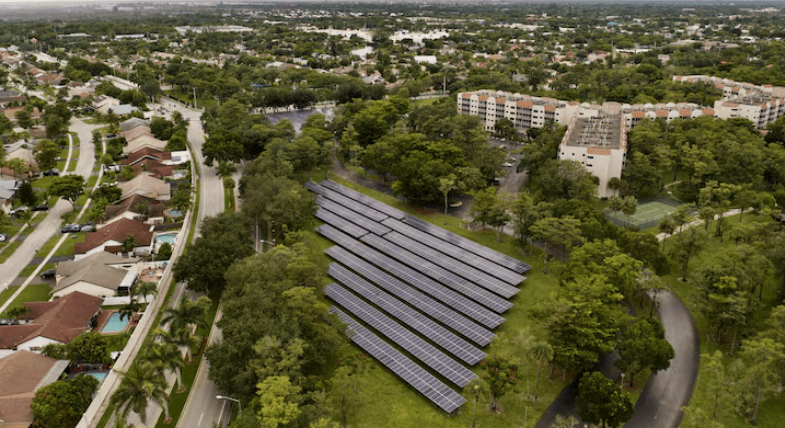
The center’s nonprofit director, Don Evans, has been referring to it as a “beacon on the hill,” a term that typically makes reporters cringe. However, the phrase sounds a little softer than it actually does when you stand in front of the building and gaze at those slanted panels that catch a gray Pittsburgh sky. He seems to mean it more as stubbornness than as marketing. Over the years, the neighborhood lost items. It’s worth keeping this one.
The economics held up even after Washington pulled the rug, which is subtly fascinating. Many similar projects nationwide stalled or shrank after Congress voted last year to phase out federal solar tax credits earlier than anticipated. Evans proceeded nonetheless. Over the next 25 years, the $1.2 million project will save about $50,000 annually and produce about 350,000 kilowatt hours annually, enough to power about 33 homes. It’s not a lucky break. It’s a hedge. Additionally, a hedge begins to seem like the wise move in a market where electricity prices are constantly rising without warning.
The Pennsylvania Solar Center’s director, Sharon Pillar, raised an issue that isn’t often brought up in these discussions. On hot, sunny afternoons, when air conditioners throughout an area are straining the grid, solar energy generates the most power. Every panel that is added to the grid relieves some of the burden on everyone’s bill. The political discourse seldom acknowledges this subtle kind of reciprocal advantage.
Even though no one is calling it that yet, other cities are keeping an eye on it. Recently, Ann Arbor introduced the first-ever residential solar direct purchase program. California is switching from the UC Merced lab to real canals for its solar canal project. A pattern is emerging, and it has nothing to do with federal policy. It comes from neighborhoods and cities that stopped waiting after determining the math was correct.
The funding component is also important. The project was funded by social impact lender Bridgeway Capital. Employee Dawn Seckler described it more as a stake in the region’s ability to survive than as a building investment. That framing is not typical. Instead of being marketed as community insurance, the majority of energy financing is still presented as a clean payback calculation.
It’s difficult to ignore how unglamorous everything is. No celebrity announcements, no dramatic ribbon-cutting, and no revolutionary promises. Just a roof that is now serving a purpose after previously doing nothing. Pillar described it as a remedy for “lazy roof syndrome,” and it’s clear that she took pleasure in saying it. It’s still unclear if the rest of Pittsburgh or the entire nation will adopt the same concept. However, the structure is generating electricity. The lights are on. Additionally, other cities are gradually beginning to replicate the assignments.⁖※
