
The tornado had already moved east, been followed by radar, and been declared over by the National Weather Service by mid-morning on Sunday, April 26. What was left in Springtown was the part that doesn’t trend: a 200-person permanent-residence RV park with significant damage, numerous Parker County homes with trees on their walls or roofs, and locals standing in the April heat, wondering what would happen next.
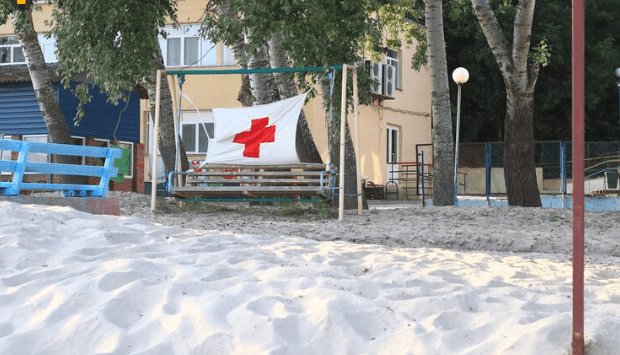
The American Red Cross established a shelter at First United Methodist Church on West Third Street as their first action. Not a short-term warming hub. Not a single night in a cot in a gym. A shelter that would serve as a foundation for what the group was already referring to as a Level 2 Disaster Relief Operation, complete with food, device charging stations, emotional support volunteers, and sufficient coordination capability.
Springtown resident Belinda Coss survived the storm. Her mobile home did not completely escape; during the tornado and hailstorm, a tree fell on it, causing damage that she was unable to repair that evening or the following morning. Her family was able to charge their phones, stay in touch with family members who were attempting to contact them, and cool off at the Red Cross shelter—April in North Texas is already hot.
That particular order of things—cool air, a functional phone, and the capacity to reassure those you love that you’re alright—is easy to underestimate. According to Belinda’s Red Cross assessment of her experience, she begins each day with her family, her creative pursuits, her corgi Prince, and the power she gains from assisting the larger neighborhood in its own healing. That is a particular illustration of what resilience looks like when the framework supporting it is genuinely stable.
Parker, Wise, Jack, Archer, and Montague were the five counties where the Red Cross response in Springtown operated concurrently. The Fort Worth office coordinated logistics and supply trailers were positioned. In Mineral Wells, a second relief facility opened. The organization upgraded the operation to Level 2, which is a mid-scale multi-county response that calls for a large staff and volunteer deployment, according to Red Cross nomenclature.
What that actually looks like on the ground: caseworkers sitting with families one at a time to determine what the next month of recovery actually requires, relief trailers loaded with cleanup kits—trash bags, gloves, and mops—being unpacked outside damaged homes, and damage assessment teams moving through neighborhoods with clipboards.
Over time, the caseworker assignment piece is the most important, yet it usually receives the least attention. It is challenging to apply for FEMA assistance without assistance. Coordinating with local housing resources, navigating the FEMA Individuals and Households Program, and comprehending the implications of the presidential disaster designation process for available help are examples of duties that call for a committed individual to walk you through the stages, not a pamphlet.
The Red Cross observed in its own communications that Springtown’s April storm also came within a broader national context: the organization is currently responding to a major new disaster around every fifteen days, as opposed to every month ten years before. Following the second-highest number of billion-dollar catastrophes in a single year on record in 2024, there was another intense storm and wildfire season in 2025. For the impacted communities, this is not an abstraction.
It indicates that the Red Cross volunteer corps is rotating through deployments at a rate that puts pressure on any humanitarian organization’s institutional infrastructure. The group does not often clearly address in its publicity releases if the fundraising base, which was largely established through the Annual Disaster Giving Program and its partner members, can meet the operating demands. Barely, depending on the year, is probably the honest response.
At least on the size of a single neighborhood over a week, the Springtown response showed that the model is essentially operating as intended. Within hours of the storm, a shelter opened. Before the entire extent of the destruction was known, supply trailers were sent out. Caseworkers were assigned prior to the resolution of the current problem. A woman called Belinda Coss was able to charge her phone and inform her family that she was safe at some point during that process, which freed her up to focus on assisting her neighbors.
This is precisely what the model is trying to achieve in terms of disaster relief. It’s not a promise. Every storm is unique, every town has different demands, and sometimes there is less of a difference between being on time and being late than any organization would like. However, the response bridged that deficit in Springtown in late April. Even if it’s tiny, that matters.
