

The controversy around AI in mental healthcare is unique in that it is both overblown and understudied. Overstated in the sense that the dread and the excitement tend to outweigh the facts. Under-examined in the sense that the clinical work is frequently not carried out by those who make the loudest claims, both in one direction and the other.
The actual findings of the research are more detailed and nuanced than either party usually permits. For mild-to-moderate anxiety and depression, AI-driven conversational tools—especially those based on cognitive-behavioral therapy frameworks—show real efficacy. This has been confirmed by several meta-analyses. These results are not marginal. CBT chatbots seem to produce quantifiable symptom reduction for a significant portion of users, including those with heightened stress, low mood, and problematic cognitive patterns. In a nation where there are about 350 mental health professionals serving per 100,000 individuals in identified shortage areas, that is a significant outcome.
AI most likely makes its strongest clinical case in the bridge role. It is not beneficial for someone to have to wait four to six months to visit a psychiatrist. A technology that can perform 24-hour triage, provide structured exercises in between appointments, or assist a patient in correctly tracking their mood over weeks doesn’t take the place of a therapist; rather, it fills a void. That’s not the same as saying “AI can do what therapists do.” Additionally, it’s likely where the majority of the significant short-term effects will originate.
However, not all of the risks receive the same level of attention. The most important issue is safety. Research from Stanford and other universities has shown instances in which chatbots either failed to recognize overt indications of suicidal intent or reacted to them in ways that were either actively destructive or clinically ineffective. Although AI empathy is based on advanced pattern recognition, it differs from clinical judgment. In the middle of a session, a skilled therapist can tell when a client has changed in a way that completely alters their needs. Current AI is unable to reproduce that type of reading, which is relational, contextual, and reliant on actual human presence. Instead of hedging, it’s worth being truthful about that.
Additionally, the majority of mainstream conversations undervalue the data privacy aspect. One of the most sensitive types of personal data is mental health information. Most of the time, wellness apps and commercial chatbots are not subject to the same privacy regulations as authorized healthcare providers. Therapy-adjacent disclosures, such as information on diagnosis, drugs, and emotional crises, have been monetized, and the legislative framework governing them is still weaker than most users realize.
Though it’s also the most speculative, predictive diagnosis is the area where AI could someday have the biggest impact on mental illness. Early accuracy in predicting mood episodes and relapses before the individual experiencing them is conscious is being demonstrated by machine learning models based on wearable data, speech intonation, and behavioral patterns. It has the potential to actually change care from reactive to preventative if it develops into clinical practice under the right supervision. How long that will take and how successfully controlled experiments translate into messy real-world implementation are still unknowns.
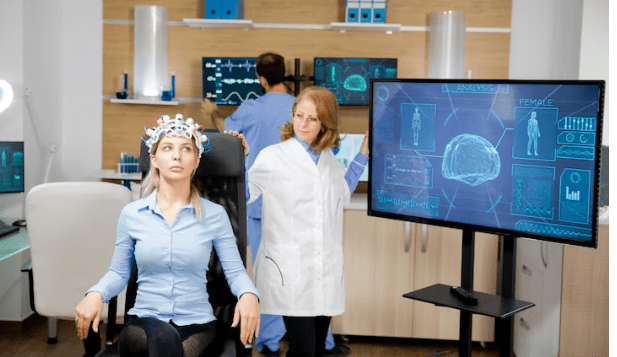
The American Psychological Association’s stance on all of this is essentially the same as that of the majority of reputable clinicians: hybrid care, in which AI expands the reach of human practitioners and lessens their administrative workload without ever taking over the therapy interaction itself.
As this discussion progresses, there’s a sense that the middle ground is actually where the honest data already points—not because compromise is always the best thing to do, but rather because the particular advantages and disadvantages of the current AI in this field naturally support it. AI is able to assist. It cannot take its place. These two elements are not at odds; rather, they represent the start of a feasible approach.
