


Every significant surgical advancement has a point at which a procedure transitions from being theoretical to something a real person experiences on an operating table. On April 27, neurosurgeon Dr. Joseph Osorio carried out the first robotic spine surgery guided by artificial intelligence on the West Coast at UC San Diego Health’s Jacobs Medical Center. The platform utilized was Medtronic’s Stealth AXiS, which combines robotics, AI, live navigation, and custom implants into what the team refers to as a single, cohesive workspace. Until you hear Osorio explain what he truly saw on that screen, it sounds almost abstract.
Spine surgery has relied on a form of controlled improvisation for many years. Surgeons use pre-operative imaging, pausing for X-rays, making adjustments, and cross-referencing mental maps with a patient’s physical anatomy in real time. It functions. However, it also has inefficiencies that are so ingrained in the procedure that most people have forgotten about them. The information architecture itself seems to be altered by Stealth AXiS, which pulls measurements, robotic arm position, navigation data, and alignment planning onto a single screen in real time as the operation progresses. That’s a big deal. That is a reorganization of the whole cognitive load associated with spine surgery.
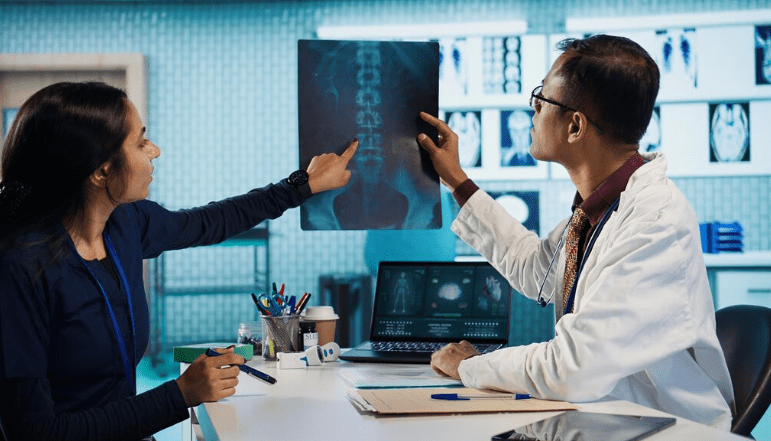
Osorio, who oversees spine surgery at the Department of Neurological Surgery at UC San Diego, was selected to launch the platform in part due to his experience with complicated cases and in part because he has been advocating for cutting-edge methods for many years. His description of how the AI works stuck with reporters: “trust, but verify.” The system doesn’t assume control. Without the surgeon physically verifying alignment against real anatomical landmarks, it cannot move forward with its data-driven recommendations, which suggest implant placements that satisfy its own strict precision standards. The robot makes a suggestion. A human makes the decision. It may not seem important, but that distinction is crucial.
The radiation question is one that is easily overlooked. Conventional spinal procedures necessitate multiple X-rays during the procedure, each of which confirms what the previous one was unable to fully resolve. That cycle is significantly shortened because Stealth AXiS continuously monitors spinal movement. The patient will receive less radiation. Less for the surgical team spending hours in that room. Though it’s too soon to tell, this detail might prove to be just as important as the precision improvements.
It is worthwhile to consider the larger picture here. Robotic surgery has been steadily growing since da Vinci made headlines in cardiac and prostate procedures, so this isn’t the first AI-assisted surgical platform the industry has seen. However, integrating robotic delivery, live AI planning, and patient-specific implants into a single real-time workspace is a different level of integration. In the words of Alexander Khalessi, chief innovation officer at UC San Diego Health, “patients leave the OR knowing their surgeon’s technical goals were actually met.” For a population dealing with lengthy spinal fusion recoveries, that assurance is not insignificant.
The East Coast rollout was already in progress, as evidenced by the fact that debut cases in Kentucky and Virginia came before those in San Diego. However, the significance of the West Coast milestone transcends geography. Osorio’s early involvement suggests this won’t be a one-time showcase, and UC San Diego has established a reputation for adopting cutting-edge procedures more quickly than most academic medical centers. Data that hasn’t been gathered yet will likely determine whether the platform becomes standard procedure or stays a specialized tool for complex cases. As of right now, one surgery was performed. Standing next to a robot, a surgeon examined one of the screens and made a modification regarding the process.
