


Dr. Joseph Osorio was getting ready to insert six screws into a patient’s lower back on a Wednesday morning in late April at Jacobs Medical Center in La Jolla. He had performed thousands of these operations in the past. The sound of a new machine in the corner and the fact that an algorithm had already determined the precise location of those screws with some degree of certainty were what made this time different.
UC San Diego Health is the first hospital on the West Coast to implement the Medtronic system, known as Stealth AXiS. It’s the kind of moment that seems more significant in a press release than it actually is. Dramatic flourishes are absent. All a surgeon needs is a CT scan, a 3D model, and a software recommendation that can be silently overruled, modified, or accepted. For what it’s worth, Osorio made changes. tiny ones. Two millimeters here, one millimeter there.
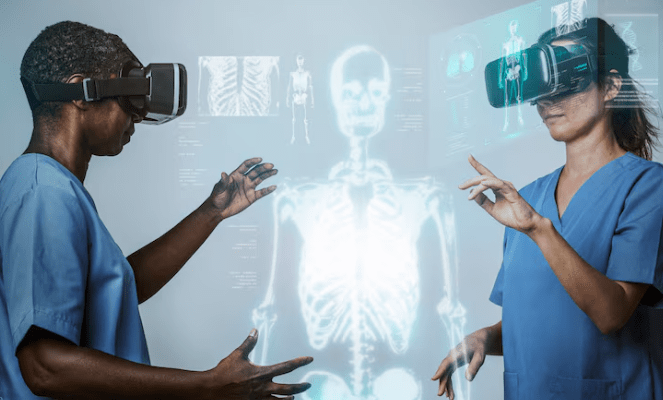
His description of the experience has an almost commonplace quality. He draws a comparison between the AI and the writing instruments that people use on a daily basis. He said, “It gets you to the neighborhood, then you tweak.” As a neurosurgeon who completed a fellowship at Columbia and received training at UC San Francisco, that comparison is not as applicable to a tech executive. The software is not necessary for him. Nevertheless, he has decided to use it.
However, the ramifications go far beyond a single operating room. One of the most popular and varied procedures in American medicine is spine fusion. The experience of the surgeon, weariness, the angle of a single screw, and the alignment of a single vertebra continue to have a significant impact on the results. Theoretically, a system that combines robotic screw delivery, intraoperative imaging, patient-specific implants, and AI planning could flatten that variability. Additionally, it is the type of thing that subtly elevates the bar for what patients should anticipate from any large hospital.
It gets interesting in the final section. When a premier academic institution in Southern California implements such a technology, the pressure moves north. Stanford, UCSF, Cedars-Sinai, and the major systems in Portland and Seattle all keep a close eye on one another. Even if they are unaware of it, patients observe as well. Eventually, a family in Orange County considering where to send a parent for surgery will want to know if their hospital has the robot. if the surgeon intends to use AI. if the screws are positioned within a millimeter of the desired route.
As this develops, it seems as though a quiet arms race in surgical technology is about to begin on the West Coast. Not ostentatious, not loud, but genuine. Referrals and headlines go to hospitals that move first. Waiting hospitals will eventually have to explain why they didn’t.
There is still room for skepticism. AI has a track record of overpromising in the medical field. Unresolved issues include insurance coverage, who is responsible when something goes wrong, and how well these models generalize to patients whose anatomy differs from the training data. The phrase “trust, but verify,” which Osorio himself employs, seems like the appropriate stance. Not amazement. Not fear. Just a working surgeon, moving on after adjusting screws by a millimeter.
Even so, it’s difficult to ignore the direction that things are going. Real-time sensor data, patient-specific implants, and an algorithm trained on thousands of prior cases. The technology is no longer just theoretical. It is working in a room in La Jolla. Whether they like it or not, the rest of the West Coast is currently catching up.⁖※
